Finally, somewhere to put your drink at open play.
122 reviews · 4.9 average · 98 verified purchases
Steadi Labs LLC — Scott Rodriguez, founder. Veteran founded.
3419 E Chapman Ave #411, Orange, California · hello@steadilabs.com
“First time I have ever ordered from Facebook feed. Very easy. Happy with product.”Steve Butler · 8 August 2026
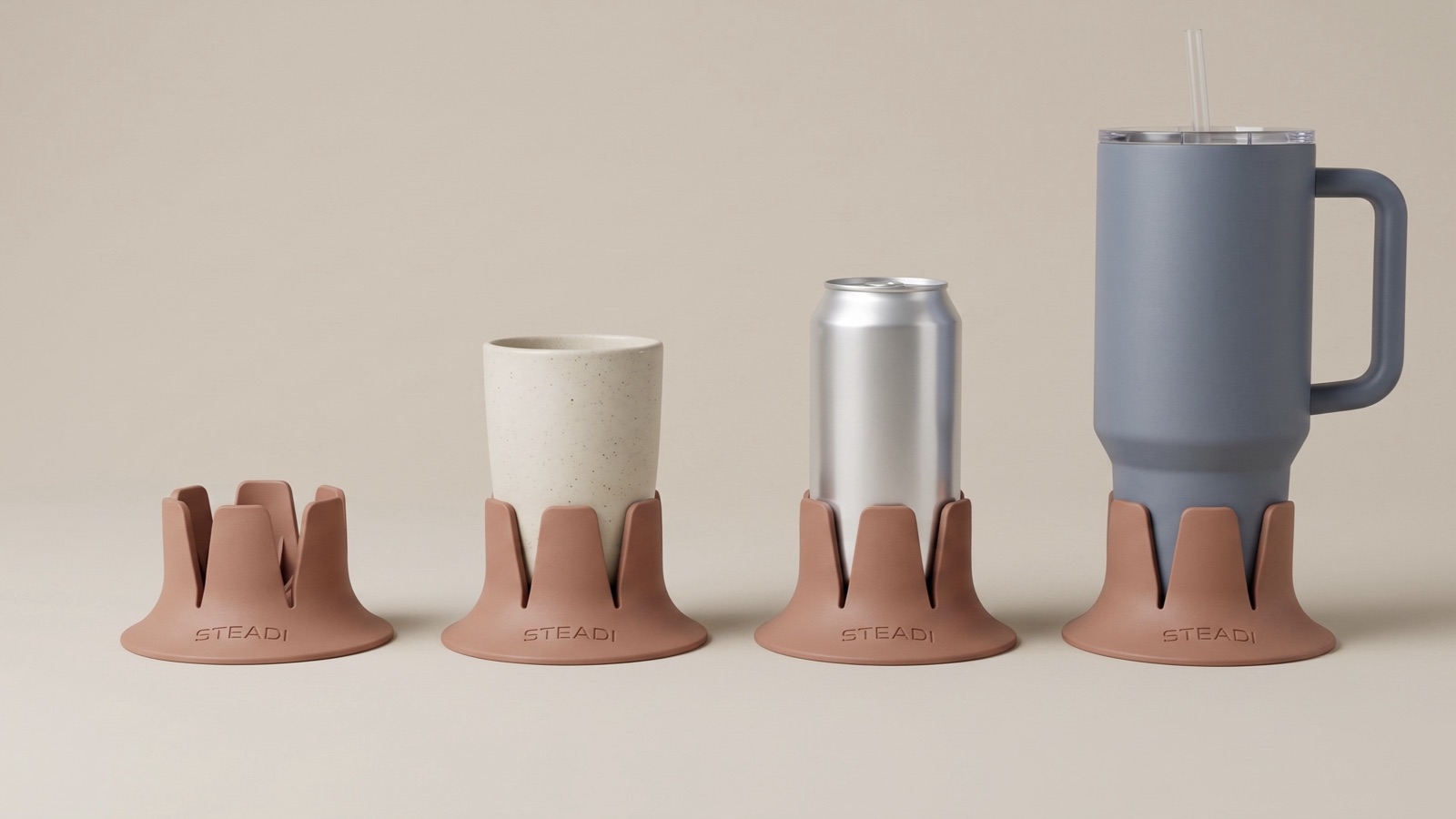
A flexible-finned base that holds your tumbler, bottle, or can steady on the bench, the fence apron, or the grass outside the gate — still upright when the next game calls you back.
Get one for the bench — from $14.95Fits the 40 oz tumbler you already bring · Free shipping · 90 days to try it at the fence line
The status quo
The rulebook covers the net. It never mentions your water bottle.
USA Pickleball's own construction guidance spells out the net height, the fence height, even the minimum runoff around the court — and never once mentions where a drink goes. At most public courts, it defaults to whatever's nearby: the ground, a shared bench, the grass outside the gate.
USA Pickleball's own spec leaves as little as about five feet between the sideline and the chain-link — the overrun lane where players chase down lobs and wide balls. That's also where the row of tumblers stands, at ankle height, directly in the way.
USA Pickleball lists benches as an optional amenity, not a requirement — plenty of public courts split one narrow slatted bench between two or three games' worth of players. Whatever gets set down there competes with paddle covers, towels, and phones, and takes a hit each time someone reaches for their bag.
Public courts sit in turf that's often graded away from the pad for drainage and dew-slick through morning open play. A tall bottle leans on the uneven ground and goes over; a narrow base just sinks into the clumps.
Narrow aluminum planks with gaps between rows, flexing under every footstep as the open-play line sits down and stands back up. A top-heavy tumbler barely wider than the plank doesn't need a shove to go over.
A soft dome that reshapes with each zipper pulled open — there's no flat spot on a bag that's just been dropped courtside, and the side pocket built for a bottle points sideways the moment the bag lies flat.
None of it ruins a session. It's the same small shuffle every single game — find a spot, hope it holds, get back to it before the next rotation calls your name.
It's happened to you
This is what open play actually looks like.
The game ends, four players jog off to re-rack paddles and four more walk on — straight past the row of tumblers lined up at the gate. Ninety seconds to towel off, spot yours among four identical ones, and drink before the next game starts.
The ball sails over your partner's head and you turn and sprint the five or six feet of runoff toward the chain-link — right through the spot where the bottles are standing on the ground.
Play stops cold, someone jogs the fence line to toss the stray ball back, and the trip there and back cuts right past the drinks parked along the mesh.
The tumbler you set in the grass outside the gate has been sweating in full sun since game one. It comes up slick, the ground under it is uneven, and setting it back down straight is a two-hand job.
Eight players rotating through and a single bench between them. Your bottle's buried under two paddle covers and somebody's pullover, and the moment the guy next to you grabs his bag, everything on the slats slides.
The fit test
The whole fit test takes one sticky note and ten seconds.
lands in here
A square sticky note: 3 inches, exactly — same ceiling as what fits at the fence.
A standard sticky note is a 3-inch square — that's just true of sticky notes, and it happens to be the top of the range that fits.
Whatever's going in the bag for the courts — the 40 oz straw tumbler, the stainless bottle, the game-day can — look at the bottom, not the lid. Tumblers taper and lids flare; the base is the only measurement that decides if it fits at the fence.
Base sits inside the edges? It fits. Hangs over? Too wide for the grip. A little puck lost in the middle — under 2 inches? Too narrow to hold steady.
No ruler at the courts, no guessing at the store — one sticky note at home tells you before you ever get to the fence line.
Fit verdicts
The bottom inch decides what comes courtside.
One rule decides every verdict below: a container base of 2 to 3 inches across settles into the fins and holds steady. Everything else follows from that.
- 40 oz straw tumbler (Stanley Quencher-style) fits
- 26 oz stainless bottle (Yeti Rambler-style) fits
- 28 oz squeeze bottle (Gatorade-style) fits
- 24-32 oz flip-sip bottle (Owala-style) fits
- 12 oz can fits
- Drive-through iced coffee cup fits
- 32 oz wide-mouth bottle (Hydro Flask-style) too wide
- Half-gallon jug too wide
- Coffee mug, handled handle in the way
There's a floor as well as a ceiling — under 2 inches, the base sits too loose in the fins. The wide-mouth bottle and the jug are the honest ceiling exceptions; the handled mug is the honest handle exception — the base is fine, the handle is exactly where a fin needs to grip.
The full fit database — Stanley, Red Bull, Yeti, and 30 more, with sourced base measurements →
Other routes
What's already strapped to the fence, and why it doesn't last a season.
| A chain-link fence cup holder | The Pickleball Cup Holder | |
|---|---|---|
| Works on bare chain-link | Built for exactly this — hooks right on | No hook needed, sits on the apron just as well |
| Indoor courts, solid walls, windscreen fencing | Nothing to hook onto — no fix at all | Sits on the bench, the bag, or the ground |
| The bench between games | Still hanging at the fence, not the bench | Sets down there just as easily |
| Court to court when you rotate | Unclip it, carry it, re-hook it | One grab, comes along |
| What's actually holding the tumbler up | Moves the tip point from ground to fence | Wide base and fins spread the load itself |
| Hardware exposed to dew and fence vibration | A clip hinge that can rust or loosen | One piece — nothing to rust or work loose |
| Cost | Another single-purpose gadget to pack and track | One small piece |
They only work where there's bare mesh to grab — nothing to hold onto at indoor courts, on solid walls, or on fencing wrapped in a windscreen. And a drink hanging at the fence still isn't at the bench, where players actually sit between games. One maker's own product history admits an early version warped in summer heat before they redesigned the material.
Sized for a 12 oz can, and it collapses sideways under a full 40 oz tumbler. The chair itself usually sits on grass outside the fence anyway, so the drink is out of reach for the whole game regardless.
Built for a slim bottle, not the big handled tumbler most people actually bring. Courtside bags get dropped flat the second you're on the court, and once the bag's lying down, the side pocket just points sideways.
The bench slats and the bag shuffle tip a tall tumbler; the ground puts the straw at shoe height in the exact overrun lane where players chase down every wide ball — the failure every fence-holder vendor points to as their reason to exist.
The value
Three reasons it settles in at open play.
Holds steady wherever you set it down
Bench slats, uneven turf outside the fence, the fabric top of a gear bag — the wide, low base spreads its grip instead of balancing on a point. It settles in on a shifting bag or a bumped bench and holds steady through the next footstep or elbow.
Holds what you actually bring to the court
The 40 oz straw tumbler, the stainless bottle, the can, the drive-through iced coffee before morning drills. Bottles and cans slide on; tumblers and cups drop in through the fins and get gripped by the bottom inch — a grip, not just a stand.
Goes with you, court to court
One piece of matte flexible material, easy to grab off the apron or the bag and carry to the next court when you rotate. No clip to unhook, no clamp to work loose — it doesn't read as gear, it just keeps the drink upright.
From the reviews
What buyers say.
Recent reviews of the Steadi, from every room and rig it lives in.
I have a tendency to spill my drinks and have two cats. This is one of the best things I’ve ever impulse bought. It works. It actually works. It’s a heavy, wide enough base that it is actually stable. My “spot” in the living room is near a somewhat-cushioned fabric ottoman, which is where I usually put my drinks. It’s
Dixie · 2026-08-30Excellent!
Brian S. · 2026-08-27It’s great love it
gilbert a. · 2026-08-24I never knock over my water at night anymore!
Steadi customer · 2026-08-2198 of the 122 published reviews are for the drink base itself. The other 24 are about ordering, shipping and customer service.
Why more than one
Two identical Stanleys. Whose lob was that?
Every foursome has a moment at the gate where two tumblers look exactly alike — same size, same shape, same lid — and nobody's sure whose sweat is on which one. It's a small thing, but it's the kind of thing that stalls a changeover for a full minute while the next four players wait to walk on.
Build your set
Give everyone their own.
Pick a pack, then give each one a color — so nobody has to ask which drink is theirs.
Fair questions
You're probably thinking…
No hook, no clip, no bare chain-link required — it sits on the bench, the bag, or the ground, and works indoors and on windscreen-wrapped fencing, where a clip-on has nothing to grab.
The 40 oz Stanley is named by size in the fit list because it fits. Run the ten-second sticky-note test at your own counter before you ever pack the bag — a base about 2 to 3 inches across settles in.
Honest answer: it resists tipping and settles back from a bump or a graze off a shared bench. A direct hit is still a direct hit, same as anything sitting out in the open at the fence line.
Free shipping on every order, a real 90-day guarantee, and one molded piece with nothing to break — plus multipacks that split easily with the regular foursome.
Goes with you court to court — no clip to unhook, one grab off the apron or the bag when you rotate, as easy as picking up your water bottle.
Honest answers
Asked at the fence line, answered here.
Does it really work at the fence line?
That's the point of the shape. Chase-downs, stray balls, footsteps along the apron — the wide, low base spreads across the sloped, hard-packed apron and the fins hold the drink by its bottom inch, so a bump settles it back instead of sending it over. It resists tipping; it isn't glued down, so a direct kick is still a direct kick.
What about the bench, or the bag, or the grass — anywhere that isn't flat?
That's the surface this base is built for. Uneven turf, narrow bench slats, the soft top of a gear bag — the base spreads its grip and settles back down instead of tipping the moment the ground underneath changes, whether that's a footstep on a bleacher plank or someone grabbing their bag.
It's been sitting in the sun since game one — does that matter?
Not to the base. What changes is your drink, not the holder — an insulated tumbler will still sweat and a bare can will still go warm by the second game, same as it would on the ground.
Will my tumbler fit?
Measure the base, not the lid. A base 2 to 3 inches across settles in — the 40 oz Stanley does. A wide-mouth bottle or a half-gallon jug runs wider than that and won't.
Does it hook onto the fence?
No — it doesn't clip to chain-link, and it doesn't need bare mesh to work. It sits on the bench, the bag, or the ground outside the gate, which means it also works at indoor courts and on fencing wrapped in a windscreen, where hook-style holders have nothing to grab.
What happens if a stray ball hits it?
A glancing hit from a stray ball rolling through on a "ball on!" call is exactly what it settles back from. A direct shot from close range is a harder ask for anything sitting out in the open.
Will this stop my tumbler from getting mixed up with everyone else's?
No — that's a different problem. Rows of near-identical insulated tumblers are common enough at open play that some fence-holder vendors sell name tags for exactly that reason. What this does is keep your drink upright and where you left it until you're back for it.
Does it work on hard courts too, not just grass and bags?
Yes — it holds at least as well on the fence apron or any hard, flat surface. The wide base and the grip keep a bumped drink from sliding or going over, which matters on a crowded bench too.
How do I clean it?
Rinse it, wipe it down, or put it in the dishwasher. It's one piece of flexible material with nothing to come apart — no mesh to mildew, no clip to rust.
Who makes it, and where do I buy one?
It's called the Steadi, molded in small runs in Orange, California by Steadi Labs. Every order ships free from steadilabs.com, with 90 days to change your mind.
Ninety days of real open play.
Bring it to the courts for a month. If it doesn't do what this page says — on the bench, the bag, or the fence line — email hello@steadilabs.com and it gets made right. No forms, no fight.
Veteran-founded · Patent pending · Made in Orange, California
Origin
Molded closer than your nearest court.
The maker is Steadi Labs, a small veteran-founded company in Orange, California. It's injection molded in small runs, and nothing about it travels far — the mold, the material, and the color runs all sit within about three and a half miles of the shop, closer together than the courts at a weekend round robin. The people who make it read hello@steadilabs.com themselves, usually before the first open-play session of the day.
Keep the drink standing, court to court.
Wherever you left it — bench, bag, or the grass outside the fence — it's still standing when the next game calls you back.
Keep it standing — ships freeCheckout is on steadilabs.com — Steadi Labs is the company that makes it.